Rules and ethics
How UK HMRC VAT rules shape sales enablement software pricing
Sales enablement software VAT: how HMRC place-of-supply tests, reverse charge and UK VAT rates shape cross-border SaaS pricing for finance teams.
What to take away
- Sales enablement software is a digital service, so HMRC VAT applies wherever the customer is, not where your servers sit.
- B2B cross-border SaaS sales usually fall under the reverse charge, which means the buyer accounts for VAT.
- Most enablement subscriptions are standard-rated at 20%, with no reduced or zero rate for content libraries.
- VAT changes the cash price you quote, your margin and how you model annual contract value.
- Invoices need the right VAT number, place-of-supply evidence and records kept for six years.
How HMRC treats sales enablement software as a digital service
HMRC classes sales enablement software as a digital service when it is supplied over the internet with minimal human intervention. A platform that hosts playbooks, call recordings, content libraries and coaching modules fits that description.
The test is not what the software does, but how it reaches the buyer. If a customer logs in and uses the tool without a person at your end doing the work each time, it is digital.
That matters because digital services have their own VAT rules. They do not follow the old default that services are taxed where the supplier is based. Instead they follow the customer.
A London enablement vendor selling to a Manchester sales team charges UK VAT. The same vendor selling to a Dublin team does not charge Irish VAT if the reverse charge applies.
HMRC's guidance on VAT rates on different goods and services sets out how software and similar supplies are treated for UK pricing. VAT rates on different goods and services - GOV.UK
One common mistake is assuming a downloaded desktop tool is different from a cloud platform. For VAT, both can be digital services if delivered electronically.
Another mistake is treating implementation, training or managed services as part of the same digital supply. Those can be separate services with different VAT treatment.
If you bundle consulting with the licence, you need to decide whether it is a single supply or two. HMRC looks at what the customer is really buying.
Build customer location into your quote logic before you build the product roadmap. That keeps the quote logic aligned with the place-of-supply rules. It also helps finance teams explain the VAT treatment to sales.
Place-of-supply tests for UK and cross-border SaaS deals
Place of supply decides which country's VAT applies. For digital services, the general rule is the place where the customer is located.
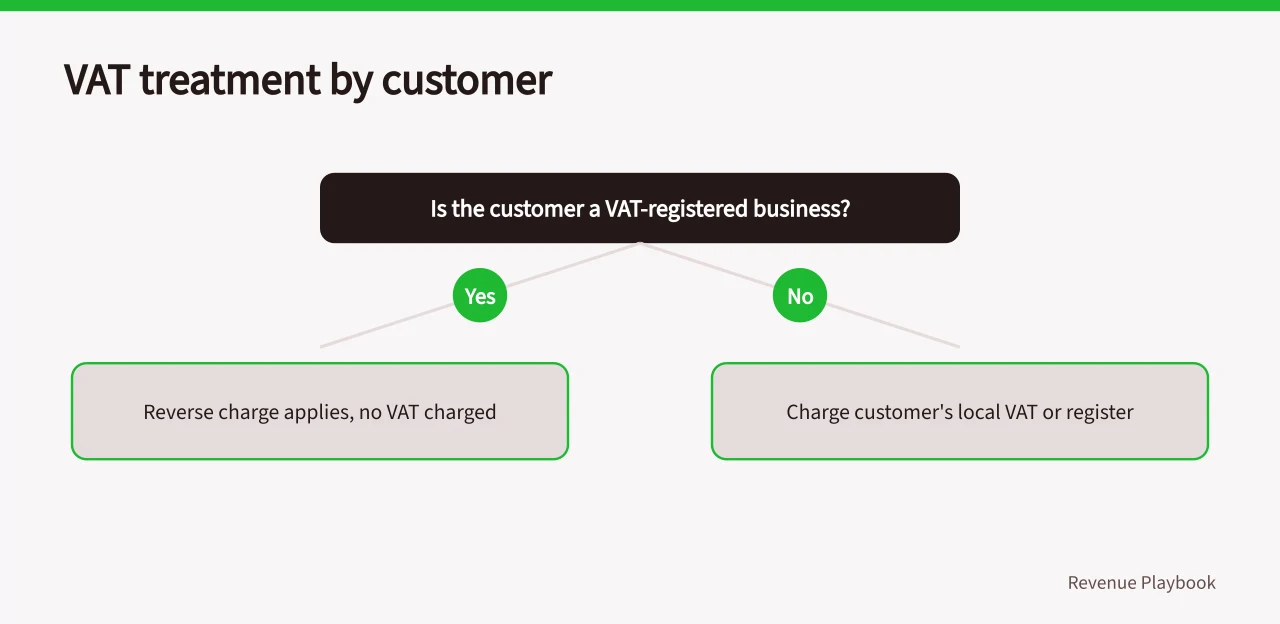
That rule applies to both B2C and B2B sales, but the mechanics differ. B2C sales usually mean you charge the customer's local VAT. B2B sales usually mean the reverse charge.
For B2B, you need to know whether the customer is in business and where they are established. A valid VAT number is the usual evidence.
If the customer is in the UK and VAT-registered, you charge UK VAT at the applicable rate unless the reverse charge applies. Domestic B2B sales are normally standard-rated.
If the customer is outside the UK and in business, the place of supply is their country. The reverse charge usually shifts the VAT accounting to them.
If the customer is outside the UK and not in business, you may need to register and charge VAT in their country. That is where cross-border SaaS pricing gets complicated.
Thresholds matter. Many countries have registration thresholds for non-established suppliers, but the UK does not have one for digital services supplied to UK consumers.
For UK vendors, the practical sequence is: identify the customer, confirm business status, check the VAT number, then apply the right treatment.
A table helps finance teams see the pattern.
Place-of-supply tests
| Customer type | Customer location | Typical VAT treatment |
|---|---|---|
| UK business, VAT-registered | United Kingdom | UK VAT charged, usually 20% |
| UK consumer | United Kingdom | UK VAT charged at the applicable rate |
| Overseas business | EU or elsewhere | Reverse charge, buyer accounts for VAT |
| Overseas consumer | EU or elsewhere | Local VAT may apply, registration may be needed |
That table is a starting point, not a substitute for checking each country's rules. Cross-border SaaS pricing depends on getting each row right.
For UK readers, the biggest exposure is usually EU B2C sales. If you sell self-serve seats to consumers or sole traders in the EU, you may need to register under the non-union scheme or use an intermediary.
For example, a UK vendor selling a 100 pound self-serve seat to a consumer in Ireland charges Irish VAT at 23%, so the consumer pays 123 pounds. That is a B2C sale, so the vendor cannot use the reverse charge and must register or use the non-union scheme.
The EU one-stop shop (OSS) non-union scheme lets a non-EU business register in one member state and file one return for B2C services across the EU. The union scheme has a 10,000 euro annual threshold for EU-established businesses selling cross-border telecommunications, broadcasting and electronic services.
The non-union scheme does not share that threshold, so a UK vendor may need to register from the first sale.
Place-of-supply tests also affect how you present prices. If you show a single global price, VAT can erode margin in some markets and not others.
Good pricing models work by mapping VAT treatment to each customer segment before setting list prices.
Reverse charge and VAT registration for B2B enablement sales
The reverse charge is the mechanism that shifts VAT accounting from the supplier to the business customer. For cross-border B2B digital services, it is the default.
Reverse charge vs UK VAT
Cross-border B2B
- VAT charged
- No
- Invoice note
- Reverse charge applies
- Customer action
- Accounts for VAT
UK B2B
- VAT charged
- Yes
- Invoice note
- Standard VAT invoice
- Customer action
- Pays VAT, reclaims
If you are a UK vendor selling to a VAT-registered business in Germany, you do not charge German VAT. You invoice without VAT and note that the reverse charge applies.
The customer accounts for the VAT in Germany, usually by including it on their own return. They may recover it if they can reclaim input VAT.
For the supplier, the key obligations are evidence and invoicing. You need the customer's VAT number, the place of supply and a clear statement on the invoice.
If you are a UK business selling to another UK business, the reverse charge generally does not apply to digital services. You charge UK VAT as normal.
The reverse charge does apply to some domestic construction and similar services, but not to standard software subscriptions.
For cross-border SaaS pricing, the reverse charge means your headline price is not inflated by foreign VAT. That can make your offer look cheaper than a local supplier that must charge VAT.
But it also means the customer has a compliance step. Some buyers prefer a local supplier that handles VAT for them, even at a higher headline price.
VAT registration is separate from the reverse charge. If you are UK-based and sell only B2B cross-border digital services, you may not need to register in the customer's country.
If you sell B2C digital services into the EU, you likely need to register somewhere. The one-stop shop and non-union scheme exist to simplify that.
For UK-only sales, you must register for VAT once turnover passes 90,000 pounds. The standard rate is 20% as of publication. HMRC publishes updates when either figure changes.
Once registered, you charge VAT on UK sales and can reclaim input VAT on business costs. That can change your effective pricing.
A worked example helps. Suppose an enablement vendor sells 100 seats at 50 pounds per seat per month to a UK business. The VAT-inclusive price is 60 pounds per seat.
The same vendor sells to a German business. The invoice states, 'Reverse charge: VAT to be accounted for by the recipient.' It shows 50 pounds per seat with no VAT, and the German buyer accounts for 19% German VAT under the reverse charge.
The vendor's revenue is the same in both cases, but the cash collected differs. UK sales bring in VAT that must be paid to HMRC later.
That timing difference matters for cash flow. Finance teams should model VAT receipts separately from revenue.
For a fuller view of costs and pricing, see how English teams handle enablement spend.
Standard, reduced and zero rates: what applies to enablement content
Most sales enablement software is standard-rated at 20% in the UK as of publication. That includes SaaS subscriptions, licences and digital content libraries.
VAT rates on enablement content
Standard-rated
- SaaS subscriptions
- 20%
- Printed training manual
- No
- Downloadable PDF manual
- 20%
- Commercial online training
- 20%
Zero-rated
- SaaS subscriptions
- No
- Printed training manual
- Yes
- Downloadable PDF manual
- No
- Commercial online training
- No
Exempt
- SaaS subscriptions
- No
- Printed training manual
- No
- Downloadable PDF manual
- No
- Commercial online training
- Rarely
There is no reduced rate for software as such. Reduced rates apply to specific goods and services like domestic fuel and children's car seats, not to business software.
Zero rates apply to things like books, newspapers and certain food. Digital versions of publications can be zero-rated if they meet the conditions, but a sales playbook library is not a newspaper.
That distinction matters if you sell content as well as software. A training manual in print may be zero-rated. The same manual as a downloadable PDF is usually standard-rated.
If you sell a bundle of software and printed materials, you may need to apportion the price. HMRC expects a fair and reasonable split.
Some vendors try to treat enablement content as education, which can be exempt in limited cases. That rarely works for commercial sales training delivered online.
Exemption is narrow. It applies to certain education providers and qualifying bodies, not to a SaaS platform that happens to host training videos.
For cross-border SaaS pricing, the UK rate is only one input. The customer's country may apply a different rate, and the reverse charge may remove it from your invoice.
If you sell to a UK charity or a public body, check whether any relief applies. Some supplies to charities can be zero-rated, but digital services usually are not.
Capital allowances are a different question. If a business buys software as an asset, it may be able to claim capital allowances rather than deduct the full cost as a revenue expense. Claim capital allowances: Overview - GOV.UK
That matters for large perpetual licences. For subscriptions, the accounting treatment is usually revenue, not capital.
Inflation also affects pricing decisions. When the ONS reports changes in consumer price inflation, vendors often use it as a benchmark for annual uplifts. Consumer price inflation, UK - Office for National Statistics
VAT is charged on the VAT-exclusive price, so an inflation-linked uplift increases both the net price and the VAT collected.
For UK buyers, the practical check is whether the quoted price includes VAT. B2B quotes are usually exclusive, but consumer-facing pages often show inclusive prices.
Cash price and margin effects of VAT on UK enablement subscriptions
VAT changes the cash price a UK buyer pays, even though it does not change your revenue. A 20% rate adds a fifth to the invoice total.
VAT impact on pricing
- 20%UK standard VAT rate
- 1,000 poundsnet monthly list price
- 1,200 poundstotal paid by UK business
- 200 poundsreclaimable input VAT
If your list price is 1,000 pounds per month, a UK business pays 1,200 pounds. It can usually reclaim the 200 pounds as input VAT if it is VAT-registered.
For a non-VAT-registered business, the 200 pounds is a real cost. That can make your software look 20% more expensive than a competitor that is not VAT-registered.
Most established UK businesses are VAT-registered, so the reclaim usually happens. But cash flow still matters, because the buyer pays the VAT before reclaiming it.
For cross-border SaaS pricing, the invoice currency and exchange rate can change the cash amount collected. That matters when you quote in euros or dollars. It also affects the VAT amount shown on the invoice.
For B2C sales, VAT is not reclaimable. That makes inclusive pricing more sensitive to rate changes.
If you sell to consumers or sole traders, a VAT-inclusive price of 120 pounds gives you 100 pounds net at 20%. If the rate changed, your net would change unless you adjusted the price.
VAT also affects discounting. A 10% discount on a VAT-inclusive price reduces both your net revenue and the VAT you pay.
Some vendors quote VAT-exclusive prices to businesses and VAT-inclusive prices to consumers. That is allowed, but it must be clear.
Price localisation adds another layer. If you show prices in euros or dollars, you need to decide whether VAT is included and at what rate.
For UK sales enablement software, the safest approach is to quote exclusive of VAT to business customers and state the rate that will apply.
That avoids surprises at invoice stage and reduces disputes. It also makes your pricing model easier to audit.
When you cost sales enablement, separate the net price from the VAT.
Invoicing, evidence and records HMRC expects from SaaS vendors
HMRC expects a VAT invoice to show specific information. For a full VAT invoice, that includes your VAT number, the customer's VAT number for cross-border B2B sales, the rate and the amount of VAT.
VAT invoice and evidence checklist
- Confirm customer's business status and VAT number
- Record two pieces of location evidence
- State reverse charge on invoice if applicable
- Keep records for six years
- Check who accounts for VAT with merchant of record
For reverse charge sales, the invoice must state that the reverse charge applies. It should also show the customer's VAT number and the place of supply.
If you sell to a UK business, you normally issue a full VAT invoice. If you sell to a consumer, you can issue a simplified invoice below a certain amount.
Evidence of place of supply is critical. For digital services, you need two pieces of non-contradictory evidence of the customer's location.
That can include the customer's address, IP address, bank details or SIM card country. HMRC does not prescribe one method, but it expects a reasonable approach.
Records must be kept for six years. That includes invoices, credit notes, evidence of customer location and VAT returns.
If you use a merchant of record or a payment processor, check who is responsible for VAT. The supplier of record is usually the one that must account for VAT.
For cross-border SaaS pricing, invoicing errors can be costly. A missing VAT number can mean the reverse charge does not apply, and you may have to account for VAT yourself.
A checklist helps finance teams stay compliant.
- Confirm the customer's business status and VAT number
- Record two pieces of evidence for the customer's location
- Apply the correct VAT rate or reverse charge
- Show the VAT amount and rate on the invoice
- State the reverse charge where it applies
- Keep records for six years
- Reconcile VAT collected with VAT returns
That checklist is not exhaustive, but it covers the main risks for UK SaaS vendors.
For public-sector buyers, procurement rules add another layer. Find a Tender Service notices may specify whether VAT is included in the advertised value.
If you sell through a reseller, make sure the VAT treatment is clear in the contract. The reseller may be the supplier for VAT purposes.
Building VAT into a sales enablement pricing model
Build the model with net revenue, VAT collected and cash received as separate lines. That structure keeps the VAT treatment visible for each customer segment.
Modelling VAT in pricing
- Identify customer location and business status
- Determine if reverse charge applies
- Apply correct VAT rate to net price
- Calculate VAT collected and cash received
- Model timing of VAT payments to HMRC
Start by mapping each customer segment to a VAT treatment. Then add the VAT rate and the cash timing for each segment. That keeps the model tied to the invoice and the cash forecast.
Here is a simple sequence.
Modelling VAT in a pricing model
- Identify the customer's location and business status.
- Determine whether the reverse charge applies.
- Apply the correct VAT rate to the net price.
- Calculate VAT collected and cash received.
- Model the timing of VAT payments to HMRC.
For a UK B2B sale, the model shows net revenue plus VAT. For a cross-border B2B sale, it shows net revenue only, with the buyer accounting for VAT.
For B2C sales, the model must include local VAT rates and registration thresholds. That can affect whether you can sell into a market profitably.
Sensitivity analysis helps. Test how a rate change or a currency movement affects your net price.
If you sell in multiple currencies, keep the VAT calculation in the customer's currency and convert at the appropriate rate. HMRC has rules on which exchange rate to use.
For annual contracts, decide whether VAT is charged on the full amount upfront or on each instalment. That affects cash flow and invoicing.
If you offer discounts or credits, apply them to the net price before calculating VAT. That keeps the VAT amount correct.
A common error is to apply VAT to the VAT-inclusive price. That overstates the VAT and understates your net revenue.
Another error is to ignore the reverse charge on cross-border sales. That can lead to double taxation or penalties.
When you budget for sales enablement tools, include VAT in the cash forecast even if it is reclaimable.
The UK buyer base is large. According to official business population estimates, there were 5.5 million private sector businesses in the UK in 2024. Business population estimates 2024 - GOV.UK
Most are small, which affects how you segment and price. Smaller businesses may not be VAT-registered, so VAT-inclusive pricing matters more to them.
Larger businesses are usually VAT-registered and can reclaim input VAT. For them, the net price is the real cost.
That segmentation should feed into your pricing tiers. A single VAT-inclusive price for all UK customers will overcharge VAT-registered businesses and undercharge others.
Finally, document your VAT logic in the pricing model. That makes it easier to audit and to update when rates or rules change.
Common questions
Do I charge VAT on sales enablement software sold to a UK business?
Yes, if you are VAT-registered and the customer is in the UK. The standard rate usually applies. The customer can normally reclaim the VAT if it is VAT-registered.
What is the reverse charge for cross-border SaaS sales?
The reverse charge shifts VAT accounting to the business customer. You invoice without VAT and the customer accounts for it in their own country.
Do I need to register for VAT in every country I sell to?
Not always. B2B sales under the reverse charge usually do not require local registration. B2C sales often do, subject to local thresholds and schemes.
Is enablement content ever zero-rated?
Rarely. Digital content is usually standard-rated. Some printed publications can be zero-rated, but a software-hosted content library is not.
How long must I keep VAT records?
Six years from the end of the accounting period. That includes invoices, evidence of customer location and VAT returns.
Can I reclaim VAT on sales enablement software my business buys?
Usually yes, if you are VAT-registered and use the software for business purposes. The supplier must charge UK VAT or the reverse charge must apply.